Run every coding agent in one workspace
Synara is the local-first command center for serious agentic work—run every coding agent in parallel and ship without losing context.
Already downloaded by 13,235 people
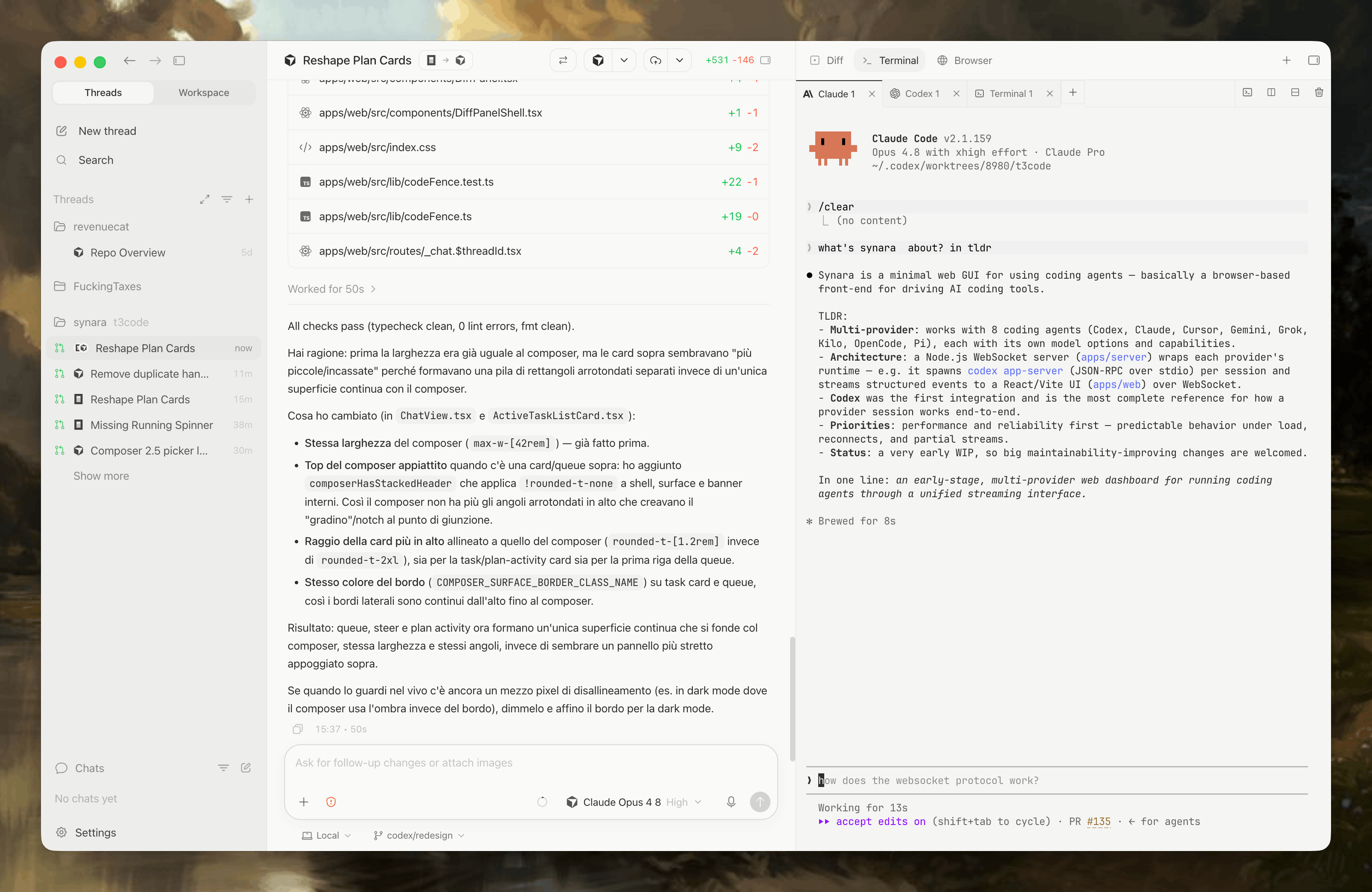
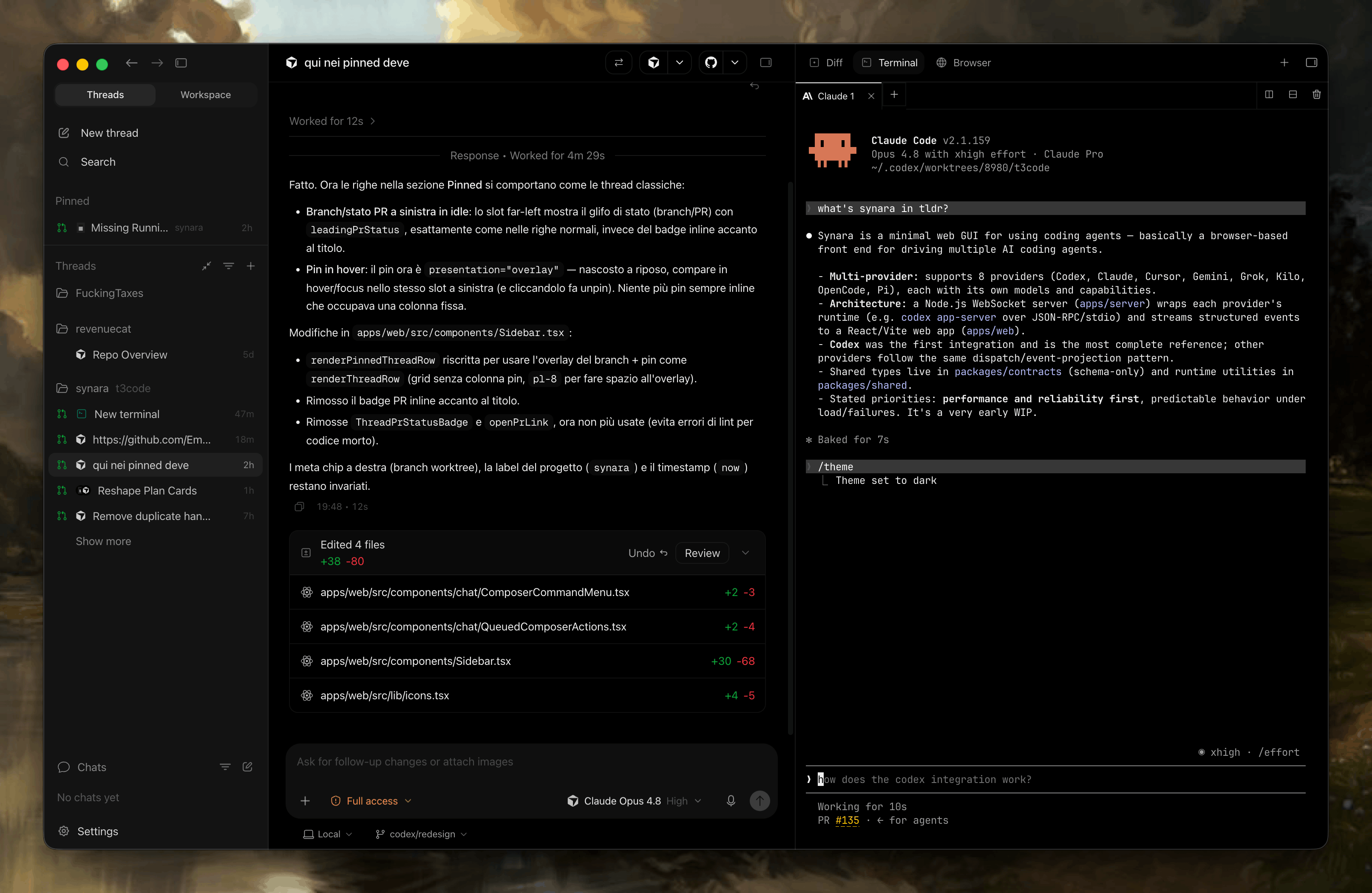
Provider portability
Keep the runtimes you already trust.
Synara sits around your coding agents rather than replacing them. Each provider keeps its own authentication, models, tools, and permissions while Synara gives the work a consistent task, environment, review, and delivery layer.
Use the Claude Code runtime and account already configured on your machine.
Run Codex tasks with the authenticated CLI, repository, and review surfaces together.
Bring OpenCode and its configured provider catalog into the same task system.
Use Cursor Agent beside other runtimes without moving the work to another workspace.
Run Antigravity with its own account, models, permissions, and session behavior.
Use Grok Build through its local runtime and Agent Client Protocol integration.
Use Kilo Code with the providers, models, modes, and agents configured in Kilo.
Run Pi with its provider registry, thinking levels, skills, and native steering.
Use Droid through its authenticated runtime, model controls, and ACP session.
Durable task ownership
One workspace. Separate tasks. Shared control.
A coding agent is only one part of the job. Synara keeps the objective, environment, live processes, verification evidence, and delivery state attached to the work from first prompt to pull request.
One task owns one line of work
Keep the objective, provider session, working directory, terminal, browser, diff, and delivery state attached to the same task.
Providers stay portable
Use the coding-agent runtimes and accounts already configured on your machine instead of moving every workflow into one vendor account.
Parallel work stays isolated
Give concurrent tasks separate Git worktrees and visible ownership so agents can build, test, and review without overwriting one another.
Results stay reviewable
Inspect commands, browser evidence, file changes, diffs, checks, commits, and pull requests before accepting the result.
01 / delivery
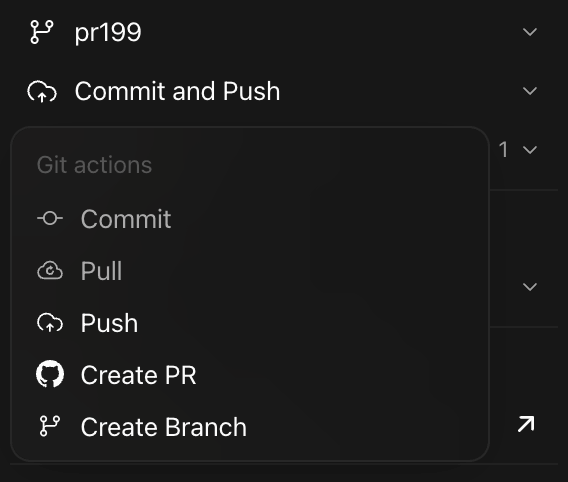
Deliver from the same task
Review the final diff, run the required checks, commit the intended changes, and open the pull request without reconstructing the work in another tool.
02 / parallel work
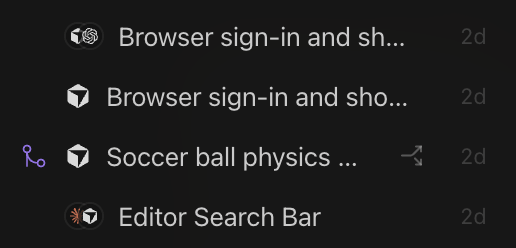
Isolate concurrent work
Give parallel tasks separate Git worktrees so each agent has a clear branch, working directory, and ownership boundary.
Keep every repository ready to resume.
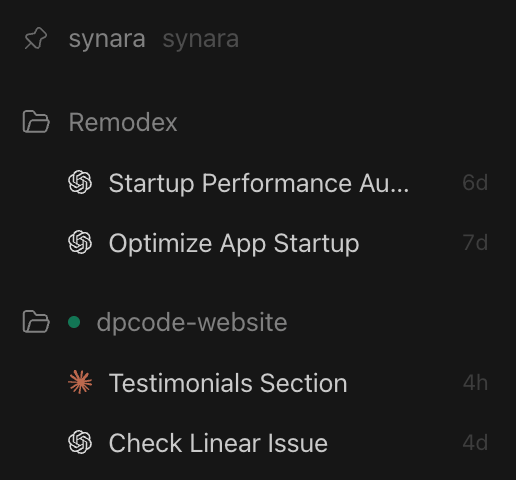
Move between products, client work, and experiments without rebuilding context from scattered windows. Each project keeps its own tasks, provider sessions, environments, and activity state.
From objective to evidence
Keep execution and verification in the same loop.
Direct several tasks, move work between providers, observe live processes, and verify the result without losing which task owns what.
03 / task ownership
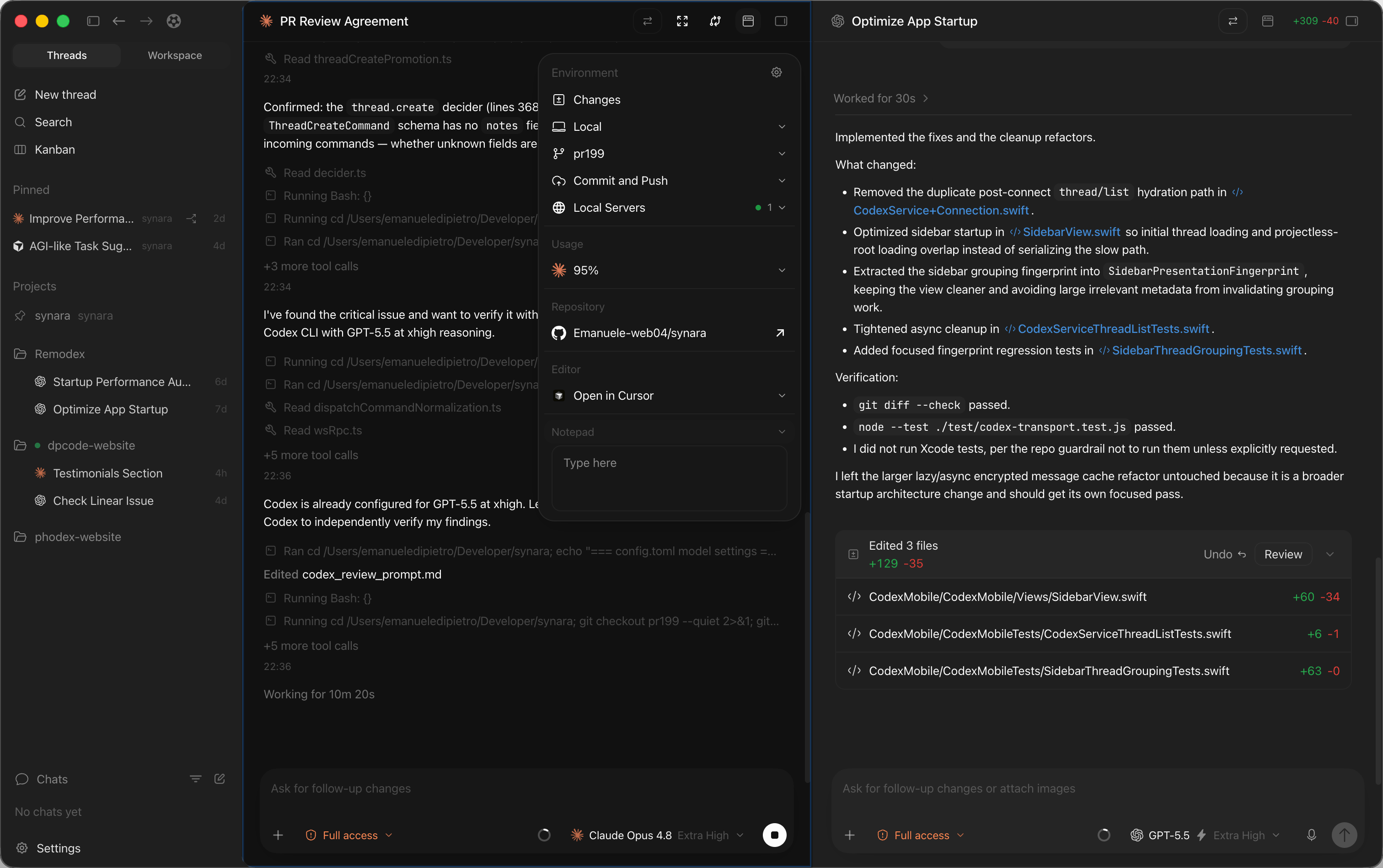
Run parallel tasks with explicit ownership
Open a task for each objective and keep its conversation, runtime, environment, and status visible instead of mixing unrelated work into one thread.
04 / provider handoff
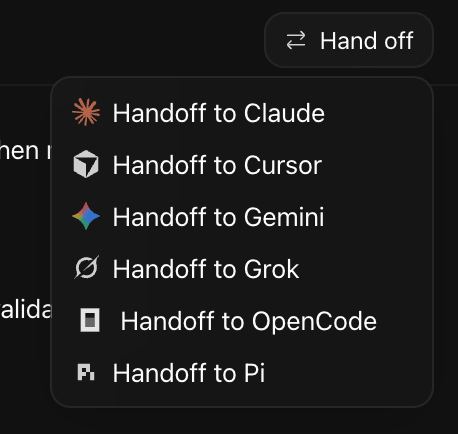
Hand the same task to another provider
Change the provider while preserving the task environment and the context Synara passes forward. Review the working tree before and after every handoff.
05 / live processes
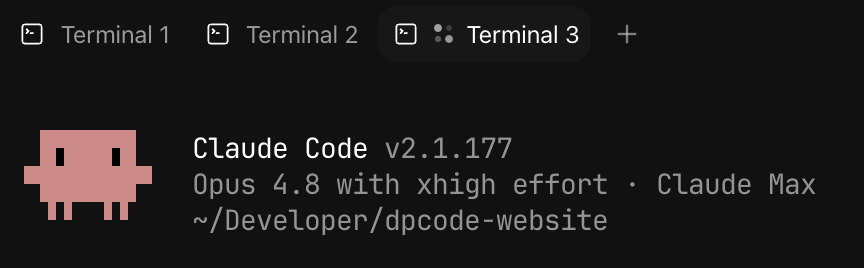
Keep long-running processes attached to the work
Run development servers, test watchers, log tails, and one-off commands beside the task that started them.
06 / verification
Verify the behavior, not only the diff
Use the built-in browser to inspect the rendered result, capture evidence, check console output, and return findings to the same task.
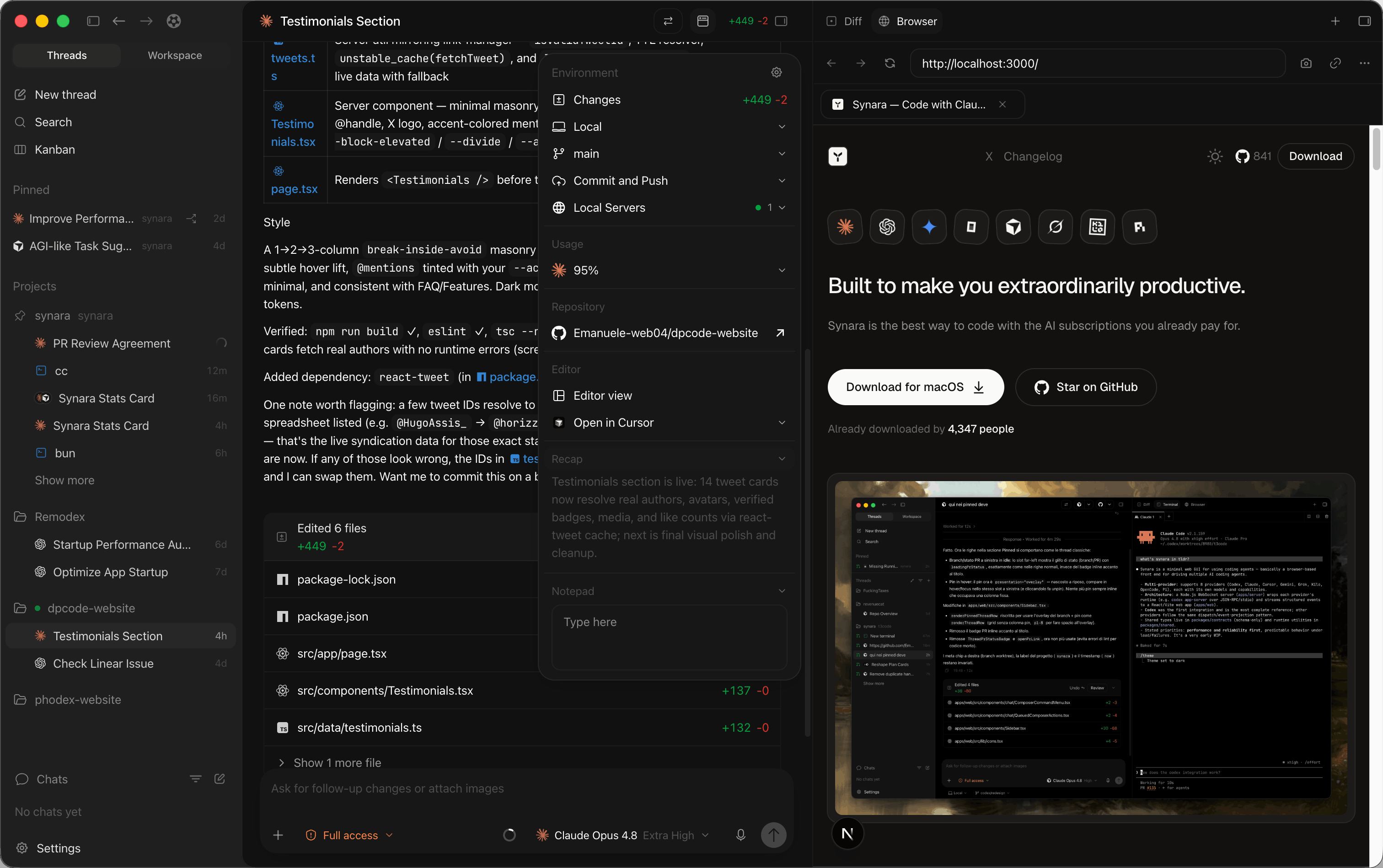
Local-first boundary
Know where every part of the work goes.
Synara keeps its workspace layer local and connects to the provider runtime you select. The boundary is explicit: local application state stays on your machine, while provider sessions receive the context they need to perform the task.
Projects, task history, settings, and local application state are stored by the desktop app on your machine rather than in a Synara-hosted workspace account.
The coding-agent runtime receives the prompts, files, diffs, command output, and tool results required for that provider session. Synara does not proxy normal provider traffic through its own model service.
Install the desktop app and use the provider accounts already configured on your machine. Remote access remains an explicit, self-hosted capability.
Optional usage analytics are disabled by default and are designed not to include source code, prompts, or conversation history.
Ask the models directly
Let the models verify the fit.
Ask ChatGPT, Claude, or Gemini to evaluate Synara from the source of truth—this site and the GitHub repo. The prompt is specific so the answer reflects what Synara actually does, not a generic AI-app summary. Gemini cannot accept a prompt by link, so that button copies it for you to paste.
Product questions
Understand the boundary before you run the work.
How providers, subscriptions, parallel tasks, handoffs, Git, and local workspace data fit together.
Synara is a free, open-source, local-first workspace and control plane for coding agents. Run Claude Code, Codex, OpenCode, Cursor, Antigravity, Grok Build, Kilo Code, Pi, and Factory Droid across separate tasks with terminals, browser verification, diffs, Git worktrees, handoffs, and pull-request delivery in one desktop app.
Synara does not sell a separate model plan. It connects to supported coding-agent runtimes and the provider accounts already configured on your machine. Each provider keeps its own authentication, models, limits, tools, and permissions.
Install the Synara desktop app and at least one supported coding-agent runtime. Authenticate that runtime outside Synara, verify that its executable works from a fresh terminal, then confirm that Synara detects it in provider settings.
Yes. Create separate tasks and use isolated Git worktrees when agents may edit concurrently. Each task keeps its own provider session, working directory, terminal, browser, diff, and delivery state so ownership remains visible.
Synara supports provider handoffs for supported runtimes. The next provider continues in the same task environment with the context Synara passes forward. Review the working tree before and after a handoff because providers do not have identical tools or session semantics.
Use a normal branch or an isolated worktree, inspect the resulting diff, run the required checks, commit the intended changes, push the branch, and open or review the pull request from the same task workflow.
Synara does not require a Synara cloud workspace account or proxy normal provider traffic through its own model service. The selected provider still receives the prompts, files, diffs, command output, and tool results required for that provider session.
From developers
What people notice when they use Synara.
Public posts about the workspace, provider choice, local server, design, and day-to-day development experience.

Synara — a coding GUI whose interface closely resembles Codex. I tried it and it really is a lot like Codex, so there's no learning curve at all. A common setup in the Chinese dev community is pairing it with Deepseek; it supports 8 popular coding agents like Pi, Claude Code, and OpenCode. I tested it with Pi + Deepseek and it works great — there's even a kanban board mode.


It'd been a while since I used DPCode so decided to give the updated @trySynara a go. Gotta say... WOW. @emanueledpt knocked it out of the park with this. Love being able to use Codex, Claude, Cursor, and OpenCode all within the same GUI.

The local server feature in @trySynara is lowkey goated


first reaction 10/10 @trySynara @emanueledpt


Why nobody is talking about @trySynara ? This app is so well designed I can't believe it

man i just CAN'T get enough of @trySynara it's just sooooo goooooooooooood

I’ve been using @trySynara (by @emanueledpt) for a few hours now. I’m really impressed. I’d already tried T3 Chat, Orca, and Terax, but none of them managed to grab my attention quite like Synara did.

@trySynara Use it almost daily, loving it so far, has almost become a part of my workflow. Founder of here

@Angaisb_ I recommend @emanueledpt open sourced Synara app Pretty good if you want something similar to codex but with claude :)
@emanueledpt @steipete @robinebers @trySynara that's why we love synara.

@emanueledpt @trySynara i love this feature, I think now i'll have to switch to synara no matter what

@emanueledpt @orca_build @trySynara's way of working with agents is exactly what I need. Of course, the design is also much better than AionUI. I knew about Synara before, but now I can finally use it since it has a Linux version. Thanks!!

@emanueledpt @AnthropicAI @trySynara Wait this looks EXTREMELY clean I'm downloading this NOW

Synara looking absolutely beautiful to work with now


@trySynara Synara keeps getting better
The local-first workspace and control plane for coding agents.
Run every coding agent in one workspace
Start with one repository and one provider. Add parallel tasks, worktrees, browser verification, handoffs, and pull-request delivery when the work requires them.
Free and open source · Already downloaded by 13,235 people